

Editor’s note: Dr. Christina Chambreau has graciously given us permission to reprint her classic article. It’s been lightly edited and updated.
How to Choose an Integrative Holistic Veterinarian
The reasons you may want to have a holistic veterinarian on your team:
- Your pet is ill and you want to treat them holistically.
- You want to prevent illness, save money and have your companion live a long life.
Who is an integrative veterinarian?
- A licensed veterinarian trained in using conventional drugs and diagnostics.
- They have also been trained in one or more different holistic approaches.
There are good ones and great ones, and you will have to discern the difference.
Some homeopathic veterinarians will consult by phone, video, or email.
Training May Include:
- Homeopathy,
- Traditional Chinese Veterinary Medicine (acupuncture, herbs and foods, moxa, Tui Na)
- Herbal Medicines,
- Flower essences,
- Osteopathy,
- Chiropractic,
- Nutrition,
- Glandulars,
- Reiki,
- Tellington Touch,
- Healing Touch for Animals
Some of these have certification programs with a year or more of courses, exams and evaluation of clinical ability. Others are either self-taught or not regulated.
Partnership
Ideally, your relationship will be a partnership where your integrative veterinarian encourages you to do all the healing modalities you want to learn. You may differ on a few topics, yet be able to acknowledge the other person’s point of view without it becoming a deal-breaker.
Some veterinarians and their staff are wonderful with your animal — others great at explaining to you what is happening with your animals. A few are good in both areas. Few veterinarians are perfect, and we all have bad days. Your animal should at least be comfortable with your choice; and you should be able to get your questions and concerns addressed.
The Holistic Veterinarian’s Perspective
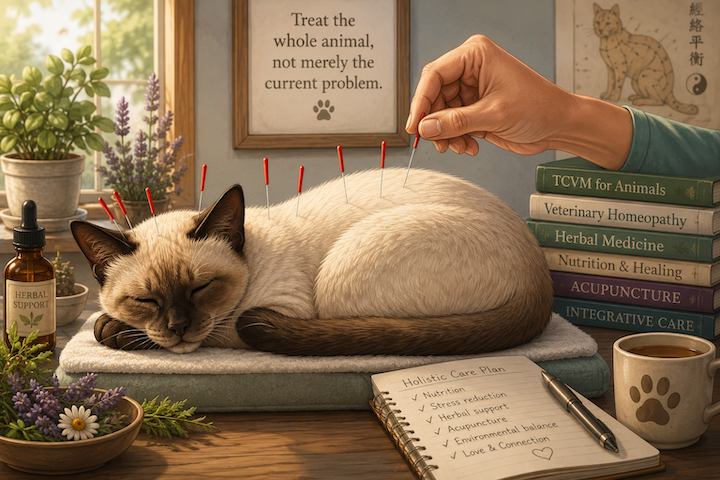
Treat the whole animal, not merely the current problem.
If there is a current problem, for example diarrhea or itching, a good holistic veterinarian will ask questions about what problems there have been in the past, what has changed in the household or the environment that may have triggered the current complaint, and if there is anything that makes the current complaints better or worse.
They will always evaluate the overall energy level of the animal. Their goal is to make the animal healthier for life, not just to get rid of the current symptom.
They will educate you and explain what they see when physically examining your animal.
A good holistic veterinarian will appreciate what you are learning at the Holistic Actions! Academy – setting the goal of deep healing and not merely symptom relief; basic health care of feeding fresh diet, few toxins, etc; that you are keeping a journal; that you want to be a partner with them rather than merely asking for treatments.
Finding a Holistic Veterinarian
STEP 1: Go to the websites for each holistic veterinary organization and read about that modality. Go to their referral list to find one near to you.
- American Holistic Veterinary Medical Association (AHVMA) VetFinder – excellent international directory with many North American practitioners.
- College of Integrative Veterinary Therapies (CIVT) – Veterinary Referral Directory – international directory with searchable listings by country, state/province, and telehealth availability.
STEP 2: Visit the website of any practitioners you are interested in.
CAUTION – Put on your critical decision making hat. It may be a very conventional looking clinic, yet the bio of the holistic vet seems excellent. Or they may rely primarily on conventional treatments despite using holistic language. (Some are on the websites because they took one class, joined the organization, then quit completely. Some are no longer in practice, etc.) Some practitioners are members of only one or two of the organizations. It’s may be best to work with a veterinarian who is an expert in just one method, but there are many excellent vets who are experienced in multiple modalities. Check them all out.
STEP 3: Do an internet search to find more possibilities – “holistic veterinarian Baltimore” or “herbal veterinarian Baltimore”.
STEP 4: Call any local holistic practitioners (chiropractors, local health food stores and even pet stores to inquire who they know).
STEP 5: If no one nearby seems like a good match, look for a homeopathic veterinarian who does phone consults.
STEP 6: Personally evaluate the veterinarian (see below).
The Nitty Gritty of Making a Selection
Once you have done the work suggested above, how do you select one to start with? How will you know if you are getting good service, and what can you do to help them help your animals?
Schedule time with the veterinarian you are interested in – pay for an appointment, offer lunch, do a phone call and ask:
What modalities are used?
What is their training?
Is their goal overall health or to merely treat the current complaint? This may be the most important question.
What organizations do they belong to, and how recently have they gone to conferences or taught?
You Are in Charge – Make Sure Your Veterinarian is Following Good Holistic Principles
They will always ask about the history, overall energy, what might have caused the current problem, the environment and what makes the symptoms better or worse.
Their physical exam will be gentle, complete and they will show you (you may need to ask) what they mean by “gingivitis, big lymph nodes, heart murmur”, etc.
They will be willing to answer your questions and explain why they are recommending a particular treatment.
If they recommend conventional treatments (antibiotics, prednisone, etc.) they will explain to you why they choose this over holistic, and give you a chance to request the more holistic treatment.
They will not do anything (vaccinate, treat) without asking your permission first.
They will recommend an individualized, minimal vaccination plan and a fresh, whole food diet. They will be open to you having a different opinion.
They will schedule follow up appointments until your animal is really healthy, with great BEAM (behavior, energy, appetite and mood) and none of the Early Warning Signs of Internal Imbalance.
What You Can Do to Help Your Holistic Veterinarian
Keep a dated journal of any problems, even little ones.
Write down any treatments given. Using the Healthy Animal’s Journal will help you know if your animal is merely getting temporary help or is really progressing to a deep cure.
Contact them if you are unable to give the treatments, or your pet refuses them.
Call if symptoms worsen, or they are less energetic and less happy, or you have concerns.
Keep working on a regular basis until your animal is in GREAT HEALTH.
Thank them!
For more information, education, and assistance, consider joining Holistic Actions! For Healthy Pets – Our Academy can help you find the right vet while you learn how to best help your pet with our vibrant community forum and experienced veterinarians.