


In 2011, Congress passed the Food Safety Modernization Act (FSMA, delightfully pronounced “Fizz-muh”). This led to the Pet Food Label Modernization effort by AAFCO. The PFLM working group, in which I participated for almost three years, spent dozens if not hundreds of hours developing the new labels as well as educational materials for regulators, veterinarians, pet food industry personnel, and consumers.
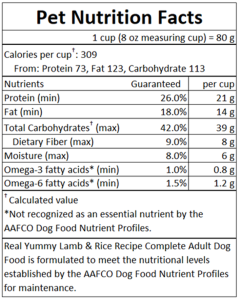
As a result, labels are changing dramatically over the next few years. The new labels will include a chart similar to those found on human food, like the example to the right, with graphics intended to simplify the label for consumers.
The new label requirements took effect January 1, 2024, but the industry has been slow to update. Before they come into common use, states need to adopt the new rules. This is a complex and potentially time-consuming process, so there is a “grace period” of six years for all pet food labels to comply.
The new Facts box incorporates several elements that were already required on labels, but weren’t previously grouped together:
- Calorie Statement
- Guarantees (formerly Guaranteed Analysis)
- Nutritional Adequacy Statement
Calorie Statement
After years of ever-increasing obesity in dogs and cats, AAFCO finally agreed that pet food labels should include a calorie statement. Common units (cup, tablespoon, etc.) must be used, as well as measurement in calories per gram or kilogram.
The Nutrition Facts box will also display the number of calories provided by each nutrient: protein, fat, and carbohydrate (with fiber listed thereunder).
Included in the Nutrition Facts box are the “guaranteed” percentages of:
- Protein (minimum)
- Fat (minimum)
- Carbohydrate (maximum)
- Fiber (maximum)
- Moisture (maximum level)
However, these items don’t necessarily mean what you might think they should.
For instance, “protein” doesn’t measure protein at all; it measures nitrogen content. (The formula is: Protein = Nitrogen x 6.25). Most nitrogen in pet food comes from protein, so it’s usually a decent ballpark estimate. But it doesn’t imply anything about the quality or digestibility of that protein.
This is exactly what went so very wrong in 2007, when a Chinese supplier of wheat gluten deliberately added a non-protein source of nitrogen to that product. Melamine, which is 66% nitrogen, made the product test higher in protein, thus commanding a better price. The supplier tried to cheat the system so he could make a few extra bucks. He ended up killing thousands of U.S. dogs and cats. He also did himself in—he was arrested, convicted, and executed for the crime.
Pet food companies do not test for melamine. Nor should they. It’s unlikely anyone would be stupid enough to try that one again. But with tens of thousands of chemicals in use in the U.S. and around the world, there is no way to anticipate or prevent similar disasters in the future.
The carbohydrate number is a calculation, not an actual analysis. Fiber is just indigestible carbohydrate. If you, or anyone you know, has ever done a ketogenic or Atkins diet, you may know that carbohydrates are often counted as “net” carbs. That is, total carbohydrate – fiber = net carbs. There’s some debate about whether total or net carbs is a better measure for a keto dieter. But for cat food, fiber gets zero credit for reducing the digestible carbohydrate.
The fiber in pet food is primarily added. It does not have the same beneficial effects as natural fiber within a food. Fiber in an apple slows down the digestion of that apple and moderates the spike in blood glucose. Soluble fibers also provide food for the microbiome. The powdered cellulose added to cat food does not. (It turns out the fiber is tricky to measure because the analysis depends on whether the food is wet, dry, cooked, or raw–another reason companies are hesitant to commit to new labels before this conflict is resolved.)
Of the four required elements, two must be listed as minimums (protein and fat), and two must be given as maximums (moisture and fiber).
Manufacturers can list anything they want in the guarantees. If it is not a nutrient in AAFCO’s Profiles, the label must state that the item is “not recognized as an essential nutrient by the AAFCO Cat Food Nutrient Profiles.” This is often seen with ingredients like Omega fatty acids.
Nutritional Adequacy Statement
You’ve probably seen AAFCO nutritional adequacy statements on cat food labels. Now it will be incorporated in the Facts box. This statement must appear on every pet food. These are the only choices:
- “(Name of product) is formulated to meet the nutritional levels established by the AAFCO Cat Food Nutrient Profiles for (life stage(s)).” This is the most common statement you’ll see. It’s the cheapest and easiest way to assure nutritional adequacy. All it takes is a nutritionist with a specialized computer program. The big companies have these nutritionists on staff. Other companies use independent consultants, who may or may not be board-certified. They may not even be veterinarians.
- “Animal feeding tests using AAFCO procedures substantiate that [name of product] provides complete and balanced nutrition for (life stage(s)).” This is considered the “gold standard.” But all it means is that the food can keep half a dozen animals alive and in average condition for six months. But even this is becoming uncommon. Under pressure from animal rights groups, most pet food makers no longer use feeding tests, and haven’t for many years. [Fiala 2018]
- “(Name of Product) provides complete and balanced nutrition for (life stage/s) and is comparable in nutritional adequacy to a product which has been substantiated using AAFCO feeding tests.” This language is reserved for products similar to a lead product that went through an actual feeding trial. These are known as “family members.” They must be similar in specific respects, and must be re-certified periodically.
- “(Name of product) is intended for intermittent or supplemental feeding ” This one is tricky, because so few people notice it. There are quite a few foods out there that do not meet AAFCO standards. While they are fine to include as an occasional treat, they are not guaranteed to provide adequate nutrition over the long term. [AAFCO 2019]
Statement of Intended Use
This statement designates the species and life stage the food is made for. There are only two life stages recognized by AAFCO: adult maintenance, and everything else. That everything includes gestation (pregnancy), lactation (nursing) and growth (kittens).
A food may be labeled for one or more stages, such as “growth and adult maintenance.” A food labeled for “all life stages” must meet the more stringent requirements for growth, pregnancy and lactation. On the new labels, these will be on the front of the package and look something like the graphic to the left, perhaps including a simple cat or dog icon.
Please notice that there is no dietary life stage called mature, senior, neutered male, juvenile delinquent, or anything else. [Vogt 2010, Kirk 1994] These distinctions are purely for marketing. [Fahey 2008]
Senior foods may be lower in protein and fat, and higher in fiber. But older cats are less able to digest and absorb their food. What they need is more and better quality protein and fat. They need plenty of moisture to prevent constipation and dehydration. Some “mature” and “senior” foods instead have less or poorer quality protein and fat. They may be harmful to older cats. AAFCO considered creating a new standard for senior foods, but concluded that there was not yet enough research to do it justice.
Safe Handling Instructions
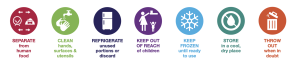
Another new label feature is the option for graphics illustrating the recommendations for safe handling. This is particularly relevant to raw food, but can be used on any package. This can be in text, or here are the icons that can be used:
Check out this article for more information on the standard terms and meanings on pet food labels.