

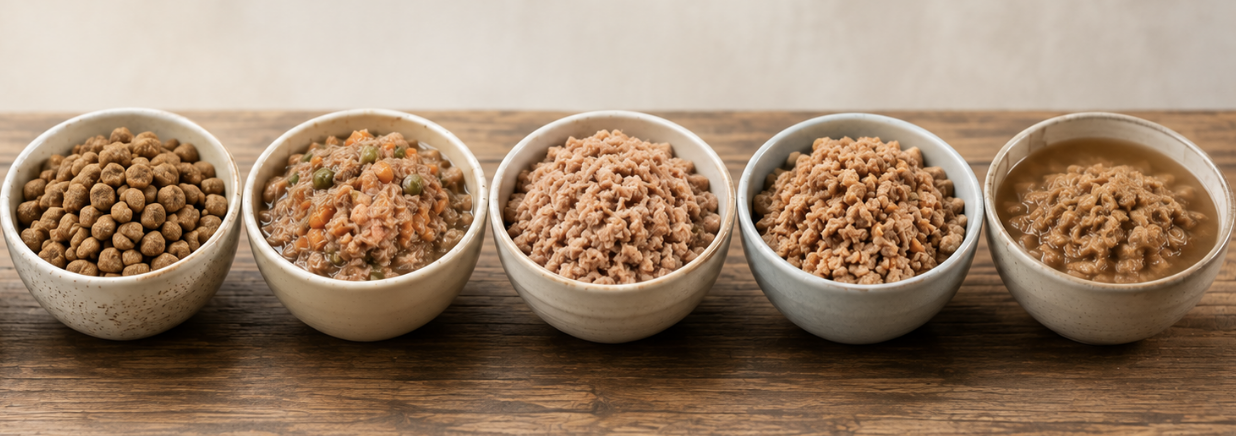
A recent study is generating a lot of discussion (and angst) by reporting that canned cat foods contained about three times more of certain “advanced glycation end-products” (AGEs) than either kibble or “mildly cooked” diets. Does this mean canned food is suddenly bad for cats?
No, not at all.
First, a little background. AGEs are created during the Maillard reaction—the familiar browning reaction that occurs whenever foods are cooked. For example, when you brown meat for a recipe, or get that golden color on a biscuit or pie crust, you are using the Maillard reaction. This reaction is considered desirable in pet food because it improves the taste.
The catch is that the longer food is exposed to heat, and the higher the temperature, the more AGEs tend to form. Actually it’s a bit more complicated than that; AGEs are the result of the interaction of processing conditions, formulation, additives, and the food matrix. But temperature is a major factor.
Not all AGEs appear to have the same biological activity, but those produced later in the process may be of greater concern. In human and animal studies, AGEs have been associated with oxidative stress, inflammation, diabetes, kidney disease, and other chronic diseases. They have not been well studied in cats.
The new study measured the amount of AGEs in different commercial cat foods. They tested only a small number of foods in each category (canned, dry, and mildly cooked). Among the foods tested, the mildly cooked diets contained the least AGEs, dry foods had more, and canned foods had the most.
It should be noted that this study was sponsored by a U.K. company that manufactures gently cooked cat food. Industry sponsorship does not invalidate the findings, particularly when the work has undergone peer review. In fact, this is a well-designed study that does not draw conclusions beyond what the data support.
Importantly, the researchers did not study cats or evaluate health outcomes. They measured AGEs in commercial cat foods, but did not look at whether those AGE levels actually affect feline health. The authors explicitly acknowledge that the biological effects of dietary AGEs in cats remain unknown.
I hope that this study stimulates more research in this area, particularly research on cats, who as we’ve seen before are the poor stepchildren of scientific studies.
But all this illustrates a broader principle that has become increasingly clear to me after more than three decades studying feline nutrition: every feeding method involves trade-offs.
- Raw diets preserve heat-sensitive nutrients but require careful sourcing, balanced formulation, and pathogen control.
- Heat processing reduces pathogens but also damages some nutrients, reduces bioavailability, and increases the formation of AGEs and other heat-induced compounds.
- Homemade diets—raw or cooked—can be outstanding, but many surveys have found them to be seriously deficient if not carefully and consistently balanced.
- Commercial diets vary enormously in ingredient quality, formulation, and processing methods.
The take-home lesson: there is no perfect cat food. Every feeding method has trade-offs. Understanding that is more useful than searching for an ideal that doesn’t exist.
Should AGEs concern us? Yes. The evidence from human and laboratory animal research is strong enough that they deserve further investigation. Manufacturers should continue looking for ways to control pathogens while minimizing heat damage during processing.
Should cat owners panic, or abandon canned food? No.
We don’t know whether the AGE levels found in commercial cat foods have any long-term health effects in cats, or whether three times more than a low level is even biologically meaningful.
More importantly, canned food still offers substantial advantages over dry food for many cats, including higher moisture, higher quality protein, lower carbohydrate levels, and only one round of heat processing as opposed to the four that dry food undergoes (which creates other non-AGE problems).
The goal is not to eliminate every potential risk—that isn’t possible. The goal is to understand the strengths and weaknesses of each feeding method and choose the approach that best fits your individual cat. For some cats, that may be canned food; for others, gently cooked or raw; and for many, it may be a combination. If a particular food doesn’t suit your cat, you can always change course. In my professional opinion, dry food is never a good option, but you still have homemade raw, homemade cooked, commercial raw, gently cooked, low-carb dehydrated, and commercial frozen or freeze-dried, and canned diets to choose from.