

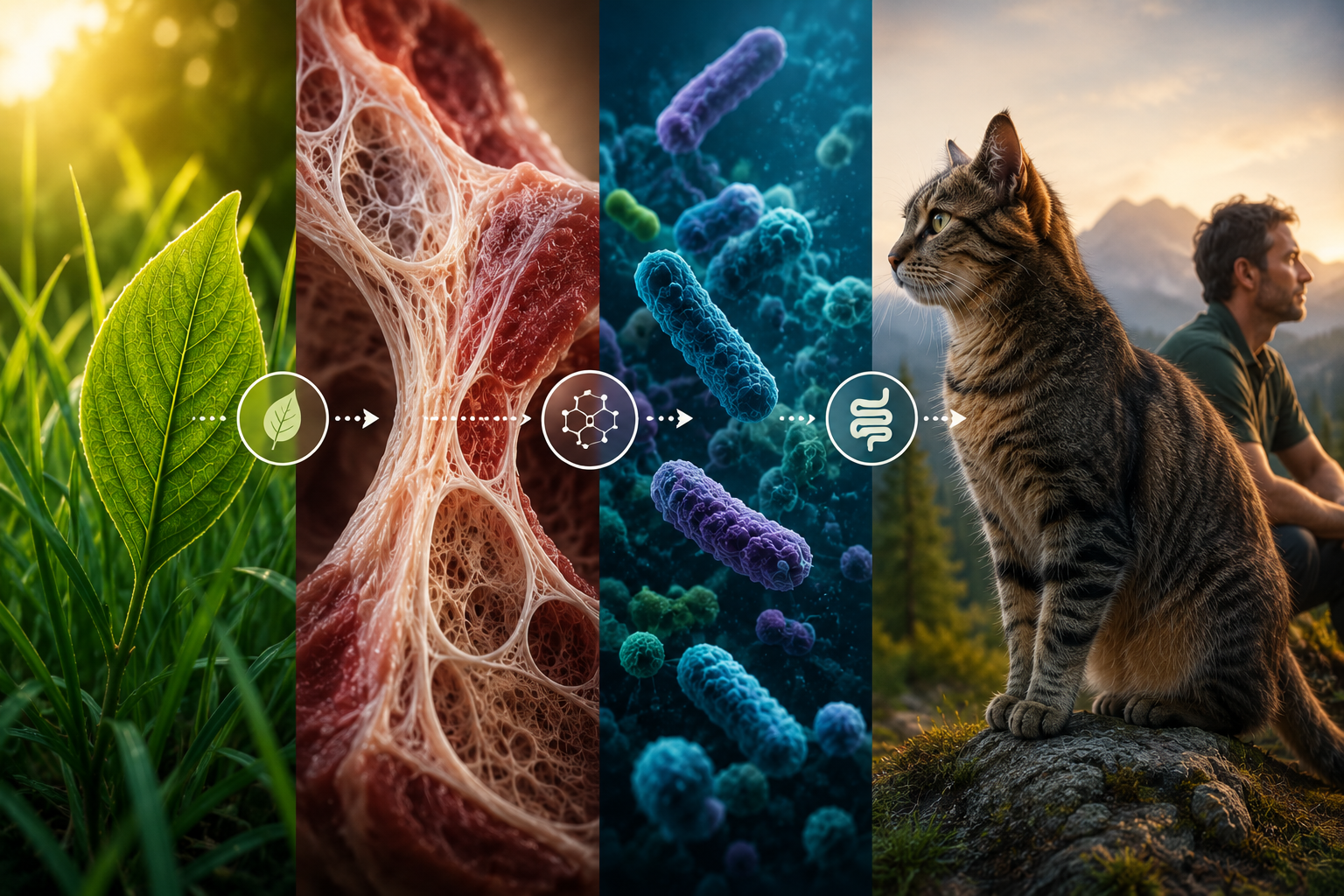
Fiber and SCFAs
It is an established dogma of nutrition and medicine that plant fiber is indispensable for good health. Thousands of studies have linked higher fiber intake with better digestive health, improved metabolism, lower inflammation, and reduced risk of chronic disease. Fiber does this by feeding the microbiome.
Fiber, which only found in plants, is fermented by microbes in the colon into short-chain fatty acids (SCFAs), including acetate, propionate, and butyrate.
We are still discovering the many vital roles of SCFAs. They help maintain the intestinal barrier, nourish the cells lining the colon, influence immunity, regulate inflammation, affect blood sugar and appetite, and act as signaling molecules that influence the brain and other organs throughout the body.
But here’s the puzzle.
Humans have no nutritional requirement for carbohydrate—not even fiber. No dietary carbohydrate has ever been identified as an essential nutrient for dogs or cats, either. In fact, no mammal has a recognized dietary requirement for carbohydrate itself, unlike protein, fat, vitamins, minerals, and certain amino acids. Yet many mammals clearly depend on dietary carbohydrate to maintain a healthy gut microbiome.
Herbivores solve this problem by directly eating plants. Omnivores solve it by eating both plants and animals. Carnivores have to solve it another way.
How Are Carnivores Getting SCFAs?
If the carnivore microbiome depends on fermentable carbohydrate substrates—and all available evidence suggests that it does—but carnivores don’t eat the plants that are the primary source of those substrates, how does nature fill that gap?
Proteins can also be fermented, but that comes at a cost. Along with SCFAs, protein fermentation produces potentially harmful by-products such as ammonia, phenols, indoles, and sulfides. Carbohydrate fermentation produces far fewer of these toxins.
If carbohydrate fermentation offers such an important advantage, it would be conserved in carnivorous species. Nature must have provided carnivores with another source of fermentable carbohydrate despite their meaty diet.
Now, all carnivores have been known to consume some plants. Cats of all sizes occasionally eat grass. (And if you have a cat, you know that they usually vomit it back up… not a good way to get fiber to the colon!). I once watched a video showing wolves grazing their way through a blueberry patch. But as a rule, lions aren’t raiding grain silos for oat bran. Wolves wandering through meadows are looking for the prey that eats grass, not the grass itself.
Yet neither canines nor felines appear to suffer from chronic SCFA deficiency. Their microbiomes function perfectly well without eating plants.
So where are the fermentable carbohydrates coming from?
We tend to think of carbohydrates as coming solely from plants—starch, sugar, cellulose, fiber. Heck, I’ve said as much myself. But I’ve come to realize that animal tissues contain carbohydrates too. We just haven’t recognized them.
The Hidden Carbs In the Carnivore Diet
For decades, the source was assumed to be the gut contents of prey animals. But many large carnivores prefer not to eat the digestive tract of their prey. Wolves and big cats will precisely excise those parts and leave them for scavengers.
Another potential source is glycogen, the storage form of sugar in the liver and muscles of the prey animal. Glycogen undoubtedly contributes some fermentable carbohydrate, but because much of it is depleted during pursuit and postmortem metabolism, it is unlikely to be the whole story.
Let’s take a quick inventory of obvious carb sources for our carnivorous friends.
- Stomach contents
- Glycogen
But that doesn’t seem like enough. Hmm. Then I got it. We’ve been overlooking an enormous reservoir of carbohydrate all along: the structural carbohydrates built into animal tissues.
- Glycoproteins
- Glycosaminoglycans
- Proteoglycans
- Connective tissue matrix
And where are all these yummy carbs coming from?
- skin
- fascia
- extracellular matrix (ECM)
- tendons
- ligaments
- cartilage
- blood vessels
- trachea
- ears
- joints
- periosteum
These aren’t obscure components that a carnivore occasionally nibbles. They’re essential ingredients in the consumption of prey.
Those tissues are loaded with proteoglycans, glycosaminoglycans, glycoproteins, hyaluronic acid, glucosamine, chondroitin, keratin. They’re carbohydrate-rich matrices, not just meat.
Instead of wondering how the carnivore microbiome works without plant carbohydrates, we should be asking where nature hid the carbohydrates inside the prey itself.
Fermentation Doesn’t Need Plants
There’s a lesson here for the human carnivore and “zero-carb” communities as well. Advocates of “nose-to-tail” eating often emphasize chomping on skin, cartilage, tendons, and fascia because they provide collagen and especially the amino acid glycine. Those are important benefits. But these same tissues are also rich in glycoproteins, proteoglycans, glycosaminoglycans, and other carbohydrate-containing molecules.
This doesn’t prove that structural carbohydrates are the primary food for the carnivore microbiome. That question remains to be answered. But they offer a biologically plausible explanation for a paradox that has largely gone unnoticed.
So the mammalian microbiome may not actually require plant fiber after all. That said, there are certainly people and animals with gastrointestinal issues who greatly benefit from eating fruits and vegetables and adding additional fermentable fiber. Doctors and veterinarians who prescribe fiber for constipation or diarrhea are not wrong.
But the opposite therapy—low residue (minimal fiber) diets—has also been equally valuable for certain patients. I’ve successfully used them for many cats whose disease had gotten worse with months or years of increasing dietary fiber.
Other animal-derived structural carbohydrates may also contribute. For example, insect exoskeletons contain chitin, another complex carbohydrate that is increasingly relevant as insect-based pet foods become more common.
This is an area that’s crying out for more research. Meantime, it’s a fun thought experiment!
References
Butowski CF, Bosch G, Hendriks WH, et al. Hydrolysed collagen and other animal-derived substrates differentially modulate in vitro fermentation characteristics using cat faecal inocula. Animals (Basel).
Depauw S, Bosch G, Hesta M, Whitehouse-Tedd K, Hendriks WH, Kaandorp J, Janssens GP. Fermentation of animal components in strict carnivores: a comparative study with cheetah fecal inoculum. Journal of Animal Science. 2012 Aug;90(8):2540-8. doi: 10.2527/jas.2011-4377. PMID: 22287677.
Depauw S, Hesta M, Whitehouse-Tedd K, et al. Animal fibre: The forgotten nutrient in strict carnivores? First insights in the cheetah. Journal of Animal Physiology and Animal Nutrition (Berl). 2013;97(1):146-154. doi:10.1111/j.1439-0396.2011.01252.x
Du Y, He C, An Y, et al. The role of short chain fatty acids in inflammation and body health. International Journal of Molecular Science. 2024 Jul 5;25(13):7379. doi: 10.3390/ijms25137379. PMID: 39000498; PMCID: PMC11242198.
Kuffa P, Pickard JM, Campbell A, Yamashita M, Schaus SR, Martens EC, Schmidt TM, Inohara N, Núñez G, Caruso R. Fiber-deficient diet inhibits colitis through the regulation of the niche and metabolism of a gut pathobiont. Cell Host Microbe. 2023;31(12):2007-2022.e12. doi:10.1016/j.chom.2023.10.016.
Ndeh D, Gilbert HJ. Biochemistry of complex glycan depolymerisation by the human gut microbiota. FEMS Microbiology Review. 2018 Mar 1;42(2):146-164. doi: 10.1093/femsre/fuy002. PMID: 29325042.
Xiong RG, Zhou DD, Wu SX, et al. Health benefits and side effects of short-chain fatty acids. Foods. 2022 Sep 15;11(18):2863. doi: 10.3390/foods11182863. PMID: 36140990; PMCID: PMC9498509.