
How to Choose a Good Cat Food
How do you know which food is best to feed your cat? The answer depends on your cat’s age, health—and your budget. But once you understand the basics, you can choose well and improve almost any diet with simple, practical changes.
That’s exactly what What Cats Should Eat: A Holistic Veterinarian’s Guide to Feeding Your Cat is designed to help you do. This book explains how to assess food quality, find what works for your cat, and make even a decent diet better with a few simple additions.
Why So Much Confusion About Cat Food?
Pet food advice is a hugely popular topic in books, magazines, and online. Unfortunately, most of it isn’t really that useful for a cat guardian trying to choose what to buy. The advice comes mainly from two camps: critics who believe the entire pet food industry is solely after your money, and the pet food industry, which portrays itself as aligned solely with your pet’s best interests. But the truth lies somewhere in the middle.
I’ve personally worked within and around the pet food industry since 1999. I’ve worked on the regulatory side, the formulation side, and the veterinary side where I see the results of feeding choices.
Based on those decades of research and experience, I wanted to create a “living” resource where cat guardians can find clear explanations, serious references, and practical guidance without hype (but with a little dose of fun and snark).
What Cats Should Eat (2026 Edition) 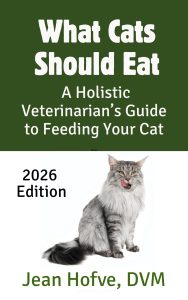
The 2026 edition of What Cats Should Eat: A Holistic Veterinarian’s Guide to Feeding Your Cat is that resource. It is my most comprehensive update yet. It incorporates up-to-date research, discusses sustainable options, and clarifies areas where confusion persists. My list of “approved” foods has been re-evaluated and radically revised based on the latest science. My goal is, as always, to help you make informed decisions that truly support your cat’s health.
What Cats Should Eat is available for Kindle on Amazon (readable on any device with a free app), or as a direct PDF download from an independent seller.
What You’ll Learn
This book clearly explains what you need to know to feed your cat well, including:
- What you can (and can’t) learn from a label, including the devious tricks manufacturers use
- How pet food is regulated—and how that affects your cat’s health
- The differences among types of food (dry, canned, raw, etc.)
- The connection between diet and urinary tract disease, diabetes, hyperthyroidism, upper respiratory viruses, aging, and cancer
- What’s actually in cat food
- How to assess a label and spot marketing tricks
- Which food forms are best for cats
- Practical feeding guidance (right down to the best type of bowl)
- How to transition your cat to a better diet
- How to make nutritious food at home
- Dr. Jean’s “approved brands” of canned, dry, and frozen/freeze-dried/raw diets; treats, toppers, and supplements (completely revised based on the latest science)
- Sustainability and the pet food industry
It also includes a glossary, resources, and more than 400 scientific references.
A Few Things That Might Surprise You
Here’s a small sampling of what you’ll learn:
- There is no dietary life stage called mature, senior, babycat, neutered male, or anything else—it’s all marketing.
- Humans don’t floss with pretzels, and dry food doesn’t clean your cat’s teeth.
- Many products that imply they’re “human grade” aren’t.
- Testing shows that many foods don’t contain what’s on the label—or contain things that aren’t listed–that you might not want.
- Dry food is easy to hide things in; once it’s rendered into powder, you can’t tell what went into it.
- Low-protein kidney diets may make your cat sicker.
- Poorly supplemented homemade diets can cause serious, preventable disease.
- Many senior diets restrict protein and fat—often the opposite of what older cats need.
- The ingredient list on many dry foods looks a lot like a list of risk factors.
- The pet food industry would prefer you not look too closely at what’s actually in the food.
Designed to Be Practical
What Cats Should Eat isn’t overwhelming. It’s written in a clear, down-to-earth style. If you want the science, it’s there. If you just want to know what to buy at the store tomorrow, that’s there too.
It teaches you how to evaluate foods for yourself—but also provides a list of high-quality options so you don’t have to start from scratch.
Get the Book
What Cats Should Eat: A Holistic Veterinarian’s Guide to Feeding Your Cat is available as:
- Kindle edition on Amazon
- Direct PDF download (for those who prefer not to use Amazon)
You don’t need a Kindle to read Kindle books—free apps are available for all devices.
If you purchased an earlier edition from Amazon, the updated 2026 version should be available in your Kindle library.
Results from Readers
- “This book should be required reading for all pet parents.”
- “I’ve already been able to reduce her insulin dose.”
- “Wow, what an eye opener… I thought I was doing the very best… but not even close.”
- “It’s become my feeding bible… my cat is healthy and thriving.”
That’s exactly what this book is designed to do—help you make better feeding decisions, step by step.
How do you know which food is the best to feed your cat? The answer depends on many factors, including your cat’s age and health… as well as the your wallet. However, whatever your budget, if you learn the basics about how to assess the quality of any given cat food, you’ll be able to find a few foods that suit your cat. And you can easily improve the quality of any diet with a couple of simple additions.