

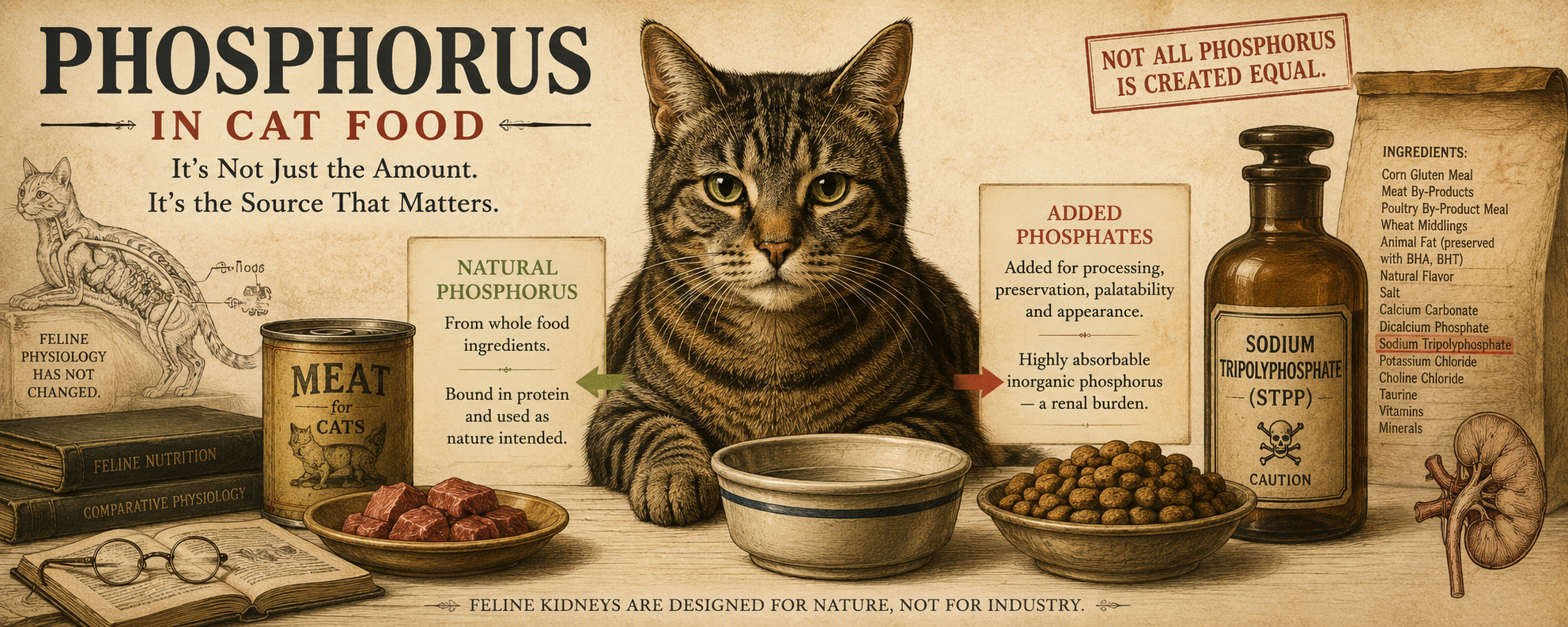
A new upper limit for phosphorus in cat food is about to be implemented. But what does that mean?
AAFCO, the Association for American Feed Control Officials, sets nutritional standards for pet food sold in the U.S. Their Nutrient Profiles for dogs and cats set minimums for 40+ nutrients including amino acids, minerals, fats, and vitamins. But very few nutrients have maximums, even though it might be beneficial for certain ingredients that can become toxic in excess.
Phosphorus has become a nutrient of concern for cats in the last several years. Research in 2018 and 2019 showed that high levels of dietary phosphorus can cause kidney damage and chronic kidney disease (CKD) even in healthy cats. Actually, research suggesting this link goes back decades—yet the pet food industry largely ignored it.
Cats Are Different
Phosphorus itself is not “bad.” Phosphorus is an essential nutrient required for normal bone structure, cellular energy production, and metabolism. Nor does it mean phosphorus alone causes kidney disease in every cat. Kidney disease is complex and influenced by genetics, hydration, inflammation, toxin exposure, aging, metabolic health, and many other factors.
What the emerging research does suggest is that source, solubility, and dose matter far more than previously appreciated. Naturally occurring phosphorus in meat does not appear to behave like purified inorganic phosphate salts added during manufacturing, even when the total phosphorus numbers appear similar on paper.
Phosphorus and CKD
Anyone who has cared for a cat with CKD is already familiar with phosphorus. For decades, phosphorus restriction has been one of the primary nutritional strategies used in managing the disease, because as kidney function declines, the body loses its ability to regulate phosphorus normally. Elevated phosphorus contributes to further kidney damage, hormonal disturbances, nausea, appetite loss, and mineral imbalance. Lowering phosphorus intake is thought to help many cats feel better and maintain stability longer.
The difficulty is that phosphorus is naturally present in the very foods cats are biologically designed to eat. Meat contains phosphorus. Organs contain phosphorus. Bone contains phosphorus. Since cats are obligate carnivores, reducing phosphorus in the diet has historically meant reducing meat content as well. This notion shaped the development of the traditional low-protein kidney diets that became standard veterinary practice for many years (even though the evidence supporting it is weaker for cats than for dogs or humans).
Unfortunately, that approach created its own problems. Cats with CKD are often older and prone to muscle wasting and weight loss due to decreased digestive efficiency, and Aggressive protein restriction may improve kidney lab values on paper—while the cat steadily loses strength and lean body mass.
The concern with protein restriction can sometimes resemble the old joke: “The operation was a success, but the patient died.” Loss of body condition is associated with a much higher risk of death than CKD itself.
Sometimes feeding the cat a food she loves is worth the trade-off: a slightly shorter lifespan but a happy cat who enjoys every day of that life.
Not All Phosphorus Is the Same
In recent years, researchers and clinicians began asking a more nuanced question: was protein itself always the real problem, or was excessive phosphorus intake—particularly from highly soluble inorganic phosphate additives—the more important issue?
That distinction has become increasingly important because not all forms of phosphorus behave the same way biologically. Naturally occurring phosphorus in fresh meat exists within complex biologic structures that require digestion and gradual absorption. In contrast, inorganic phosphate salts added during food manufacturing, including sodium phosphate, phosphoric acid, and pyrophosphates, are highly soluble and rapidly absorbed. As a result, two diets with similar total phosphorus levels may have very different physiologic effects.
Over the past decade, multiple studies have shown that highly soluble inorganic phosphate additives can produce sharper increases in blood phosphorus levels along with stronger activation of hormonal pathways involved in kidney function. Experimental studies in healthy cats demonstrated measurable kidney injury and structural renal changes in cats consuming diets containing approximately 3.6 g phosphorus/1000 kcal derived from highly soluble inorganic phosphorus sources, particularly when calcium-to-phosphorus ratios were low.
What made those findings especially concerning was that surveys of commercial cat foods found that roughly one-third of tested diets exceeded those levels.
This may help explain why some cats appear to tolerate meat-based diets containing moderate amounts of natural phosphorus far better than highly processed diets containing large amounts of phosphate additives. On paper, the phosphorus numbers may appear similar. Physiologically, they are not equivalent at all.
Why Phosphate Additives Became So Common
Historically, adult maintenance cat foods were required to meet minimum phosphorus requirements, but there was no upper limit. Over time, phosphorus levels in many commercial foods drifted upward, especially in highly processed diets relying heavily on phosphate additives for palatability, texture, shelf stability, and manufacturing efficiency.
Phosphate additives are extraordinarily useful from a food technology standpoint. They improve texture and moisture retention, help maintain kibble structure, stabilize products during processing, and enhance palatability. Cats often find phosphate-enhanced foods highly appealing, which created a strong incentive for widespread use throughout the pet food industry. (I find Diet Coke irresistible for precisely the same reason: that tangy phosphoric acid is delicious.)
The problem is that feline physiology is not built to tolerate chronic exposure to these additives.
What AAFCO Is Actually Changing
This is one reason the AAFCO phosphorus discussions represent a genuine shift in thinking. The new proposals are more sophisticated than simply setting a blanket phosphorus maximum because they specifically address highly soluble inorganic phosphorus sources, including phosphate additives.
That matters because growing evidence suggests these forms may be much harder on feline kidneys compared to naturally occurring phosphorus in animal-source ingredients.
At the same time, there is legitimate concern that the proposed upper limits are still far above levels already associated with kidney injury in experimental studies. The new limit will be 5.0 g/1000 kcal, even though experimental studies have already demonstrated kidney injury at much lower levels. So acknowledging that phosphate additives matter represents real scientific progress, but the actual regulatory thresholds may still fail to protect cats.
Regulatory standards are not based solely on ideal biology. They also reflect manufacturing practices, ingredient availability, economic pressures, and the practical realities of producing commercial foods at scale. AAFCO considers the science, but it also receives input from the pet food industry, and those competing interests can water down a good idea quite effectively. For example, AAFCO recently rejected a change for copper despite the evidence.
The pet food industry’s lobbying arm, the Pet Food Institute, did not oppose the new limits. But they did argue for an extended period for implementation (as if pet food companies haven’t known about the harm for decades). Now they will be forced to make serious changes.
In the meantime, there are two resources you can use to choose lower phosphorus foods for your cat. First is Dr. Lisa Pierson’s charts at catinfo.org, which can be sorted by phosphorus content. Second is my recommended food list in What Cats Should Eat, which I completely revamped to meet lower phosphorus limits as well as my other stringent criteria.
References
Alexander J, Stockman J, Atwal J, et al. Effects of the long-term feeding of diets enriched with inorganic phosphorus on the adult feline kidney and phosphorus metabolism. British Journal of Nutrition. 2019;121(3):249–269.
Cave N, Wall M. Protein restriction for cats with chronic kidney disease. Royal Canin Academy.https://academy.royalcanin.com/en/veterinary/protein-restriction-for-cats-with-chronic-kidney-disease
Dobenecker B, Webel A, Reese S, et al. Effect of a high phosphorus diet on indicators of renal health in cats. Journal of Animal Physiology and Animal Nutrition. 2018;102(2):e508–e518.
Gray CM, Alexander LG, Staunton R, et al. Evaluation of phosphorus, calcium and magnesium content in commercially available foods formulated for healthy cats. Journal of Feline Medicine and Surgery. 2021;23(7):634–644.
Ross SJ. Evidence-based medicine: Protein requirements in dogs and cats with chronic kidney disease. Proceedings of the American College of Veterinary Internal Medicine Forum. Available at: VIN Proceedings Archive