
Updated 9/10/25
Cats have many unique characteristics that make for some interesting health challenges, but one of the strangest is “Ripple Skin Syndrome,” or “Itchy Twitchy syndrome” (technically called “feline hyperesthesia”). This condition starts as a rippling of the cat’s skin on its back, from the shoulders to the tail; the cat may turn and lick or bite at the area; and even run away as if something frightened or hurt them.
The jury is still out on exactly what causes this problem. The first thing to rule out is a flea problem; in a flea-allergic cat, just one flea bite may cause severe and long-lasting itchiness. Flea-allergic dermatitis may cause the cat to lick and scratch, especially around the hind end and base of the tail, even to the point of serious hair loss (alopecia).
Dry or itchy skin may be a contributing factor to the problem. Adding essential fatty acids to your cat’s food, or trying a hypoallergenic diet, could be the keys to resolving the issue.
Other factors may include:
- Frequent bathing, strong fragrances, synthetic air fresheners, incense, scented candles, and harsh cleaners that can irritate or overstimulate [https://littlebigcat.com/indoor-air-pollution/].
- Repetitive “trigger” play (e.g., laser-only play, frantic chasing) that leaves your cat amped up without resolution. Always end laser play with letting the cat catch a favorite physical toy (feather wand, catnip mouse, etc.).
True hyperesthesia, in many cases, appears to be a form of seizure disorder that may respond to anti-convulsive medications. It may also fall somewhere on the behavioral obsessive-compulsive spectrum; for these cats, stress reduction measures such as play therapy, indoor enrichment, and flower essences may be helpful.
From a holistic point of view, these visible signs are the body’s way of saying “something’s out of balance.” It may be linked with stress, pain, or nervous system sensitivity rather than a single disease.
Supportive care includes:
- A peaceful home: stable routines, quiet hideaways, and play that ends before overstimulation.
- Touch therapy: gentle massage or Tellington TTouch.
- Flower essences like Skin Soother or Stress Stopper work extremely well.
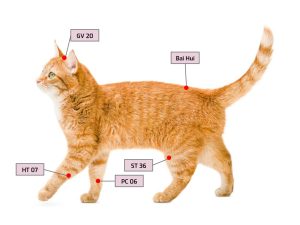
- Acupressure:
- GV-26 (centerline between nose and upper lip) for brief calming in acute moments
- GV-20 (top of head, along the ridge between the ears) is a master emotional point that works to calm the whole nervous system.
- Other calming points are pictured below:
- Environmental enrichment: daily interactive play followed by a small protein snack to discharge energy and promote relaxation [https://littlebigcat.com/play-therapy/].
- At home: run your fingers along the bladder meridian (just below the spine on both sides, from top of the neck to base of tail) and note any tender spots.
- Pain (especially along the spine or tail), dental/mouth discomfort, skin irritation, or GI issues can all fuel hyperesthesia-like behavior. A thorough veterinary exam is in order.
- Constitutional support with homeopathy or TCVM are best for rebalancing the whole system. Many cats with hyperesthesia improve significantly with individualized care.
- Feed a meat-based, moisture-rich, cat-appropriate diet (no kibble!). [https://littlebigcat.com/the-ideal-diet-for-cats/] Probiotics, omega-3s, B-vitamins and taurine supplements support the nervous system may be helpful.